



PDE8
PDE8 (phosphodiesterase 8) is a high-affinity, cAMP-specific phosphodiesterase family that regulates intracellular cAMP turnover and thereby controls cAMP-dependent signaling processes across multiple cell types[1][2]. Mechanistically, PDE8A suppresses cAMP/PKA signaling through efficient cAMP hydrolysis and participates in signaling compartmentalization by associating with specific protein complexes, including Raf-1 kinase-containing signaling modules[3][4]. PDE8A binding to Raf-1 limits PKA-mediated inhibitory phosphorylation of Raf-1 and supports RAF1-dependent ERK/MAPK signaling, establishing a functional link between cyclic nucleotide signaling and MAPK pathway regulation[3][4][5]. In immune systems, PDE8A contributes to T-cell activation, adhesion, chemotaxis, and motility, indicating an important role in inflammatory signaling and immune-cell trafficking[2][6]. Disease-relevant experimental models further demonstrate that PDE8 inhibition or disruption of the PDE8A-Raf-1 signaling complex reduces effector CD4+ T-cell adhesion and migration and attenuates autoimmune inflammation-associated responses[6][7]. Compared with the closely related PDE4 family, PDE8 exhibits substantially higher affinity for cAMP and mediates non-redundant regulatory functions, particularly in rapid T-cell adhesion and motility responses[2]. This distinction is important for experimental design because PDE8-selective modulation can affect cellular migration pathways that are not reproduced by PDE4 inhibition alone[2][6]. For research applications, the highly selective PDE8 inhibitor PF-04957325 has been widely used to define PDE8-dependent signaling mechanisms and to investigate immune and inflammatory phenotypes in vitro and in vivo[2][6].
References:
- [1]. Fisher DA, et al. Isolation and characterization of PDE8A, a novel human cAMP-specific phosphodiesterase. Biochem Biophys Res Commun. 1998 May 29;246(3):570-7. [Content Brief]
- [2]. Vang AG, et al. Differential Expression and Function of PDE8 and PDE4 in Effector T cells: Implications for PDE8 as a Drug Target in Inflammation. Front Pharmacol. 2016 Aug 23;7:259. [Content Brief]
- [3]. Brown KM, et al. Phosphodiesterase-8A binds to and regulates Raf-1 kinase. Proc Natl Acad Sci U S A. 2013 Apr 16;110(16):E1533-42. [Content Brief]
- [4]. Mukherjee S, et al. 14-3-3 interaction with phosphodiesterase 8A sustains PKA signaling and downregulates the MAPK pathway. J Biol Chem. 2024 Mar;300(3):105725. [Content Brief]
- [5]. Maurice DH. PDE8A runs interference to limit PKA inhibition of Raf-1. Proc Natl Acad Sci U S A. 2013 Apr 16;110(16):6248-9. doi: 10.1073/pnas.1303920110. Epub 2013 Apr 2. PMID: 23550163; PMCID: PMC3631695. et al. PDE8A runs interference to limit PKA inhibition of Raf-1. Proc Natl Acad Sci U S A. 2013 Apr 16;110(16):6248-9. [Content Brief]
- [6]. Basole CP, et al. PDE8 controls CD4+ T cell motility through the PDE8A-Raf-1 kinase signaling complex. Cell Signal. 2017 Dec;40:62-72. [Content Brief]
- [7]. Maurice DH, et al. Advances in targeting cyclic nucleotide phosphodiesterases. Nat Rev Drug Discov. 2014 Apr;13(4):290-314. [Content Brief]
All Product Categories
-
PDE8 Related Products (11)
Related Products (11)

- 1

-
PDE4-IN-34
 0 ImagesCat. No.: HY-181646CAS No.: 3052591-16-6PDE4-IN-34 is a phosphodiesterase 4 (PDE4) inhibitor, with IC50 values of 19 pM and 14 pM against PDE4B1 and PDE4D2, respectively. PDE4-IN-34 shows weak inhibitory activity against PDE8A1, with an IC50 value of 4.092 μM, and exhibits significant selectivity over other subtypes (IC50 > 10 μM). PDE4-IN-34 improves pulmonary function, reduces inflammatory responses and alleviates lung tissue damage in a rat model induced by cigarette smoke combined with LPS (HY-D1056). PDE4-IN-34 can be used for research related to chronic obstructive pulmonary disease.
-
PDE5-IN-13
 0 ImagesCat. No.: HY-170435PDE5-IN-13 (Compound 14b) inhibits phosphodiesterase 5 (PDE5A) with an IC50 of 3 nM. PDE5-IN-13 is a potential candidate for PAH (pulmonary arterial hypertension) research. PDE5-IN-13 has high selectivity for targets over PDE1, PDE2, PDE3, PDE4, PDE7, PDE8, PDE9, PDE10, and PDE11. PDE5-IN-13 is orally active.
-
PDE4-IN-12
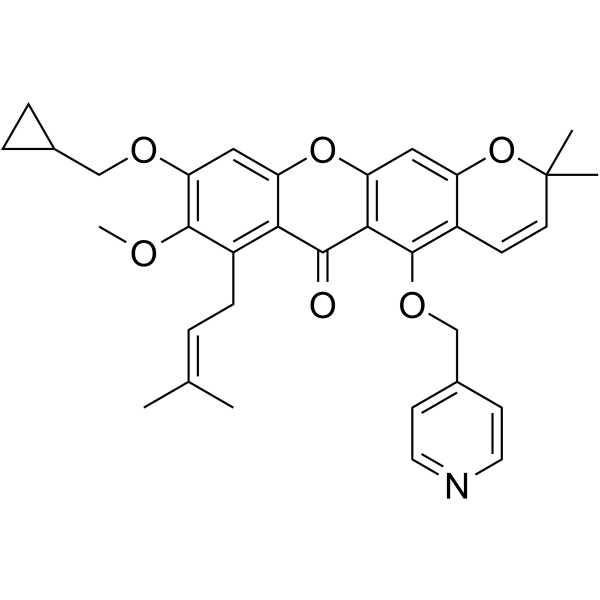 0 ImagesCat. No.: HY-151174CAS No.: 2901084-32-8
-
Multitarget AD-IN-6
 0 ImagesCat. No.: HY-181762Multitarget AD-IN-6 (Compound 39) is a multi-target inhibitor, with an IC50 of 15.54 μM against PDE4B, 15.15 μM against PDE7A, 8.39 μM against PDE3A, and a Kd of 37.7 μM against CHIT1. Multitarget AD-IN-6 acts as a TRPA1 antagonist, reduces the level of the NLRP3 inflammasome multiprotein complex to inhibit its activation, while inhibiting PDE4B, PDE7A and CHIT1, and decreasing the phosphorylation of NF-κB. Multitarget AD-IN-6 improves the pathology of elastase-induced emphysema in mice. Multitarget AD-IN-6 is applicable for the research of chronic obstructive pulmonary disease.
-
PDE/TRPA1/CHIT1-IN-1
 0 ImagesCat. No.: HY-179503PDE/TRPA1/CHIT1-IN-1 is a phosphodiesterases (PDEs), TRPA1, and hCHIT1 (KD of 37.7 μM) inhibitor. PDE/TRPA1/CHIT1-IN-1 is a broad-spectrum PDE inhibitor, potently targeting key isoforms including PDE4B, PDE7A, PDE3A, and PDE8A with IC50s of 15.54, 15.15, 8.39 and 16.46 μM. PDE/TRPA1/CHIT1-IN-1 suppresses NLRP3 inflammasome activation and inhibits NF-κB phosphorylation, downregulating the expression of pro-inflammatory genes (TNF-α and IL-6) in vivo. PDE/TRPA1/CHIT1-IN-1 can be used for chronic obstructive pulmonary disease (COPD) and related inflammatory lung disorders research.
-
BC8-15
 0 ImagesCat. No.: HY-134937CAS No.: 950385-77-0BC8-15 is a PDE inhibitor with IC50 values of 0.28, 0.22, and 6.46 µM for inhibiting PDE8A, PDE4A, and PDE7A, respectively. BC8-15 can enhance steroidogenesis in mouse Leydig cells.
-
LH17
 0 ImagesCat. No.: HY-180803LH17, a Kaempferol (HY-14590) derivative, is a potent and selective PDE4 inhibitor (PDE4D2 IC50 = 73 nM, PDE4B2 IC50 = 190 nM). LH17 exhibits remarkable selectivity (>136-fold) against other PDE isoforms (PDE1B/2A/3A/5A/8A/9A/10A) (IC50 > 10000 nM), with the exception of PDE7A1 (IC50 = 300 nM). LH17 distinctly interacts with PDE4 M-pocket. LH17 demonstrates remarkable anti-fibrotic efficacy in both in vitro and in vivo models. LH17 can be used for idiopathic pulmonary fibrosis (IPF) research.
-
PDE4D inhibitor 1
 0 ImagesCat. No.: HY-173290PDE4-IN-1 is a PDE4 inhibitor with high potency (IC50 : 8.6 nM) and selectivity over other PDE subtypes. PDE4-IN-1 inhibits the release of inflammatory cytokines and chemokines. PDE4-IN-1 greatly restores impaired cAMP-CREB signaling pathway. PDE4-IN-1 inhibits proliferation and promotes differentiation to reverse the formation of psoriasis.
-
PDE3/4-IN-4
 0 ImagesCat. No.: HY-181088CAS No.: 3088024-27-2PDE3/4-IN-4 is an orally active PDE3A and PDE4B inhibitor with IC50 values of 10 nM and 9.4 nM, respectively. PDE3/4-IN-4 shows selective activity relative to most other PDE family members. PDE3/4-IN-4 modulates the cAMP/PKA/CREB signaling pathway. PDE3/4-IN-4 inhibits pro-inflammatory factor IL-6. PDE3/4-IN-4 reduces expression of inflammatory markers in liver tissue. PDE3/4-IN-4 attenuates liver fibrosis. PDE3/4-IN-4 limits liver damage in cholestatic and sepsis-induced liver disease mice models. PDE3/4-IN-4 can be used for the research of liver injury, cholestatic liver diseases, sepsis-induced liver injury.

- 1



